Power architecture choices during initial design phases of next-generation military aircraft platforms will influence performance, upgrade flexibility, and through-life sustainment cost, says Sanjeev Sachan, Director of Engineering, TT Electronics
By Sanjeev Sachan, Director of Engineering, TT Electronics
Future air dominance platforms will be defined not only by speed and stealth, but increasingly by electrical capability. Across military aviation worldwide, there is an ongoing shift toward the development of more-electric aircraft, in which electrical power supports a growing range of complex onboard systems. This trend is also beginning to extend into adjacent domains, including space, where similar power and survivability challenges are emerging.
The US Defense Advanced Research Projects Agency (DARPA) has been exploring more-electric technologies for several years. Programs such as the Series Hybrid Electric Propulsion Aircraft Demonstration (SHEPARD), which includes an experimental prototype aircraft designated the XRQ-73, are helping to validate new concepts and technologies.
Also, the U.S. Air Force has supported multiple hybrid-electric demonstrator programs, resulting in the test flights of experimental uncrewed aircraft. As progress continues toward hybrid-electric and even fully electric propulsion concepts, electrical power systems are becoming a central factor in how future air platforms are designed, integrated, and sustained – possibly carrying through to the development of the Next-Generation Air Dominance (NGAD) Fighter.
This transition means power is becoming mission-critical infrastructure that underpins survivability, situational awareness, and mission adaptability. Consequently, as electrical demand rises, traditional power conversion architectures are being re-evaluated, with modular, bidirectional systems capable of supporting distributed energy storage and dynamic reconfiguration emerging as critical enablers of next-generation aerospace capability.
With the more-electric trend established, it is worth taking a more in-depth look at how power-architecture decisions could shape future air dominance worldwide. As radar performance advances, electronic warfare (EW) systems expand, and onboard AI processing becomes more sophisticated, electrical demand across platforms continues to rise. Secure communications and directed-energy technologies add further load complexity, along with AI integration on systems.
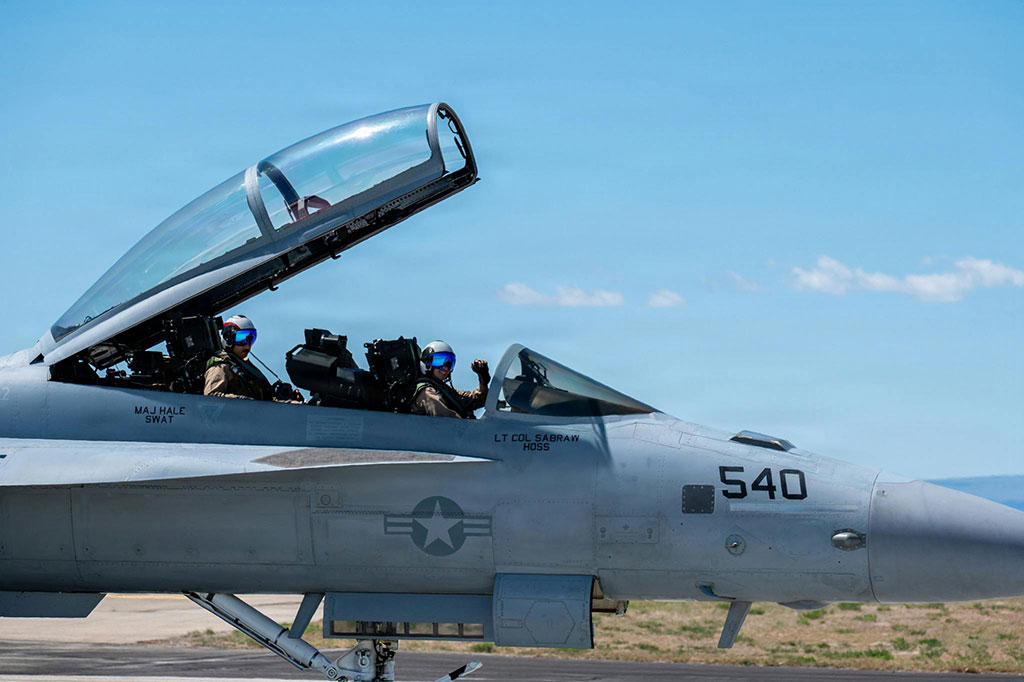
U.S. Navy EA-18G Growlers attached to the "Vikings" of Electronic Attack Squadron 129, wave while taxiing during the Gunfighter Skies Air Show at Mountain Home Air Force Base, Idaho. The EA-18G Growler has the specific mission set of electronic warfare using the latest avionics suite evolved from the Improved Capability III system. U.S. Air Force photo by Airman 1st Class Aiden Fisk.
In this environment, power generation, conversion, and distribution are no longer background systems. They directly determine how effectively mission-critical technologies perform under real operating conditions. Architecture decisions in the electrical domain now have clear implications for aircraft performance, resilience, and long-term upgrade potential.
Several parallel trends are driving higher and more dynamic load profiles. New mission systems, such as directed-energy weapons and sensor fusion, are pushing aircraft electrical loads far beyond what legacy architectures were originally designed to support. Active electronically scanned array (AESA) radar requires stable, high-density power delivery. EW systems operate with rapid transients in contested electromagnetic environments. Sensor fusion and advanced processing increase compute requirements. Electrically actuated subsystems continue to replace hydraulic and pneumatic systems, improving controllability while adding electrical demand.
Alongside these load-driven challenges, survivability requirements are also evolving as military capability continues to extend into the space domain - across communications, data infrastructure, and missile defense systems. With space dominance set to become a key factor in future military power, power supply and conversion systems must be able to withstand space radiation as well as potential nuclear events.
The challenge extends beyond total power consumption. Peak demand, burst operation, and regeneration events must be managed without voltage instability or unnecessary thermal penalties. As a result, power architectures increasingly prioritize scalable, high-efficiency conversion platforms that operate reliably within fixed spatial constraints.
All of this development must occur within strict size, weight, power, and cost (SWaP-C) boundaries. These fundamental engineering constraints mean electrification is unlikely to be solved through incremental upgrades alone. Instead, the solution will require architectural planning at the platform level.
Converters, cabling, protection hardware, and cooling systems compete directly with payload and fuel allocation. Inefficient conversion increases heat generation, which, in turn, drives additional cooling requirements and increased weight. These trade-offs influence aircraft range, endurance, and lifecycle cost.
Meeting higher electrical demand without expanding system footprint requires continuous improvements in power density, efficiency, and packaging. In aerospace and defense applications, reliability targets commonly extend toward one million operational hours, with service lives exceeding two decades. The architecture discipline, early in the program, reduces risk across that entire lifecycle.
Thermal management remains one of the principal technical constraints in increasingly electrified platforms. As power density increases, maintaining acceptable junction and system temperatures becomes more challenging, particularly in tightly constrained airframes. As military platforms evolve, primes increasingly look to deploy scalable, modular conversion platforms that are capable of delivering higher power density within the same physical envelope.
At the same time, electrical systems must operate under vibration, shock, wide temperature variation, electromagnetic interference, and increasing exposure to radiation effects. These conditions place additional demands on power integrity, fault tolerance, and controlled degradation in contested environments.
Without architectural alignment, integrating modern high-power subsystems into legacy electrical frameworks can introduce instability, electromagnetic compatibility challenges, and unpredictable fault interactions. Coordinated architectural planning reduces these risks and strengthens overall system resilience.
In aerospace programs, early alignment between power architecture, environmental qualification, and integration strategy often simplifies certification and long-term sustainment.
These combined thermal, environmental, and reliability pressures expose the limitations of earlier power architectures. Traditional aerospace systems were typically centralized, organized around fixed-voltage rails, and largely unidirectional in energy flow.
Those structures were designed for predictable load behavior. Today’s platforms operate very differently.
Hybrid storage, regenerative subsystems, and highly dynamic mission loads introduce operating conditions that depart significantly from those original assumptions. Electrically driven actuators can return energy to the system during operation, while directed-energy payloads impose short-duration, high-intensity demand.
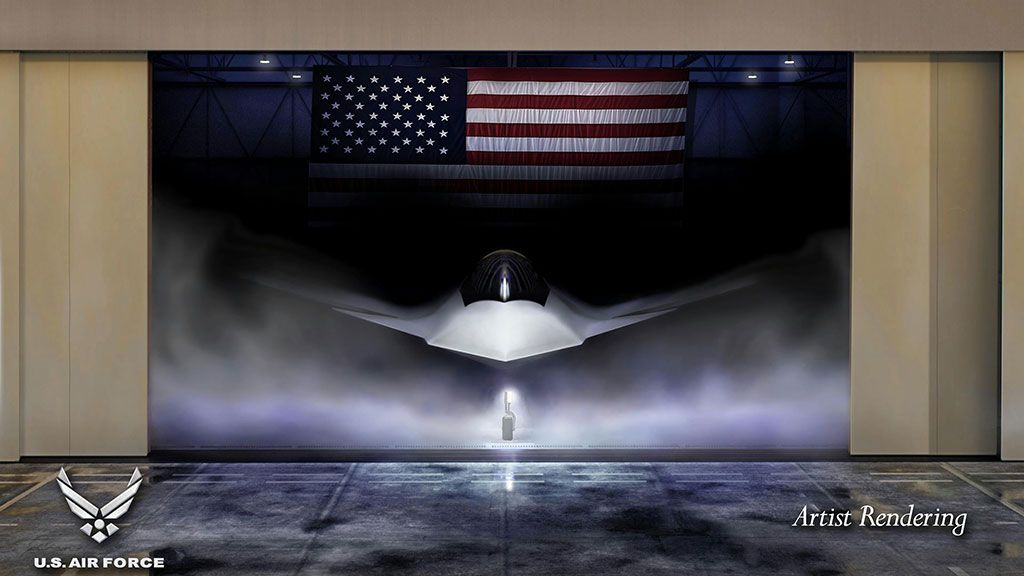
Shown is a graphical artist rendering of the Next Generation Air Dominance (NGAD) Platform. U.S. Air Force graphic.
Under these conditions, rigid architectures increase wiring complexity and reduce efficiency. Greater flexibility in conversion and distribution becomes essential.
As architectures evolve, distributed energy storage has shifted from contingency provision to deliberate design strategy. This type of capability can enable operational scenarios such as sudden burst-power demand from directed-energy systems or reduced-signature ‘silent watch’ modes where onboard systems are used without relying solely on the aircraft’s primary generation sources.
Batteries now support peak-load events, enable reduced-signature modes, and provide short-duration burst capability. In doing so, they change how energy is generated, stored, and distributed across the platform. Distributed storage also enhances resilience by reducing reliance on a single generation path.
Managing this dynamic energy landscape requires controlled power transfer between AC networks, DC buses, and storage elements. This means that regenerated energy from electrically driven subsystems can be captured and redistributed across the platform rather than wastefully dissipated as heat, improving overall system efficiency. Bi- and Tri-directional converters enable that exchange while limiting the need for complex external bus management.
Capturing and redistributing regenerated energy improves overall system utilization and moderates thermal loading.
These requirements reinforce the value of modular, bi- and tri-directional conversion platforms that simplify integration across mixed-voltage domains while maintaining efficiency and reliability.
USAF platforms frequently remain operational for 20 to 40 years and must therefore accommodate evolving mission systems without major electrical redesign. Power architecture must also support updated certification requirements and long-term sustainment planning.
Modular building blocks, industry-standard packaging formats, standardized communication interfaces, and field-upgradable software architectures support incremental modernization. These principles allow new capabilities to be integrated without extensive redesign of the underlying electrical framework
For suppliers supporting aerospace and defense programs, long-term supply chain continuity and qualification discipline are as critical as performance metrics.
Organizations with established experience in aerospace power conversion, including high-voltage and bidirectional systems, bring practical insight into architectural collaboration, compliance standards, and multi-decade sustainment. At TT Electronics, that experience informs how we work with customers across air, land, and sea platforms.
Electrical demand in advanced defense aircraft continues to expand in both scale and complexity. Radar, EW, processing, and emerging high-energy systems depend on stable, adaptable power architectures.
Addressing these demands requires careful architectural planning, disciplined thermal management, and conversion platforms that support bidirectional energy flow and modular scalability.
The most consequential decisions are made early. Power architecture choices during initial design phases will influence performance, upgrade flexibility, and sustainment cost throughout the life of the platform.
As defense organizations continue to evaluate distributed architectures, bi- and tri-directional conversion, or high-voltage power strategies for next-generation platforms, TT Electronics’ engineering teams can support early trade studies through qualification and long-term sustainment planning.
Electrical architecture is no longer a background engineering choice; it is a strategic enabler of mission capability. TT Electronics is committed to working with defense partners to realize the opportunities this transition creates.
UWTSD is celebrating another major WorldSkills UK success after two apprentices from industry partner TT Electronics qualified for the 2026 WorldSkills UK CNC Milling National Finals.
Engineering-led support will help customers explore solutions to complex aerospace and defence power requirements
Hybrid microelectronics can deliver maximum performance from miniaturised solutions in the most demanding environments